Professional solutions on concrete addtives, Concrete Foaming Agent, Superplasticizer, CLC Blocks Additives, and foaming machine


What is Foamed Concrete with Recycled Glass Aggregate?
A US landfill receives over 7 million tons of glass annually. Only 31% gets recycled. The rest is a permanent burden. Foamed concrete with recycled glass aggregate directly tackles this waste stream. It transforms discarded glass bottles and jars into a high-performance construction material.
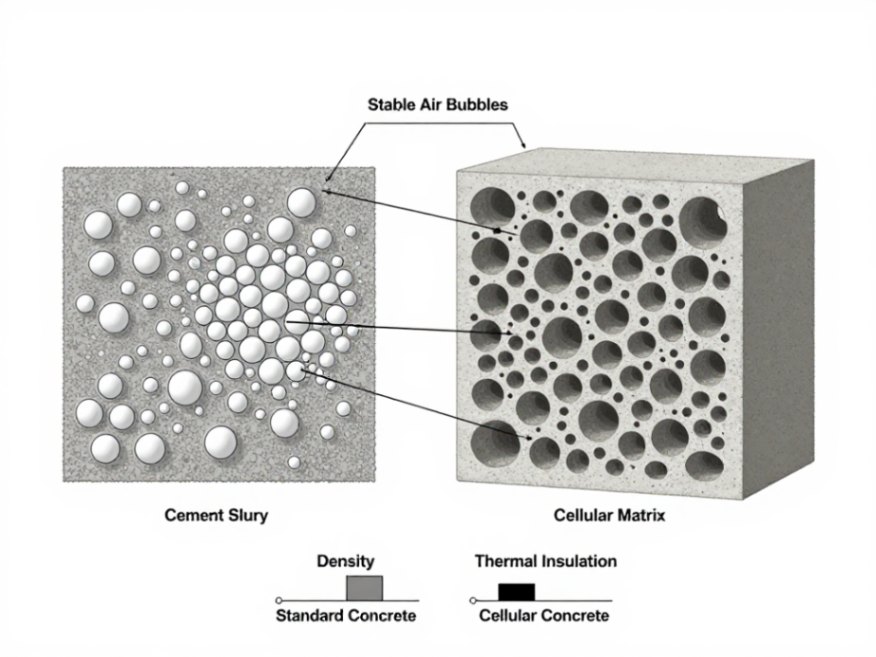
This material is a two-part innovation. First, you have lightweight foamed concrete. A cement paste gets millions of microscopic air bubbles, making it light and insulating. Second, you replace traditional sand or stone aggregates with crushed, cleaned recycled glass. The result is a composite that is lighter, greener, and often performs better than its conventional counterpart.
The Core Composition & How It’s Made
Creating this material is a precise, logical process. You cannot simply dump broken glass into a mixer. The logic follows clear steps for performance and safety.
- Cementitious Binder: Portland cement forms the base. Supplementary materials like fly ash or slag cement often join to enhance durability and lower the carbon footprint.
- Recycled Glass Aggregate (RGA): Post-consumer glass gets crushed and sieved to a specific size. It must be free of contaminants like paper, plastic, or metals. The angular shape of crushed glass improves particle interlock.
- Foaming Agent: A surfactant-based agent gets diluted with water and aerated to create a stable foam. This foam is the key to lightness.
- Water: Precisely measured for the desired workability and strength.
The mixing sequence is critical. You combine the cement, water, and glass aggregate first to form a slurry. Then, you fold in the pre-formed foam gently. This preserves the bubble structure that defines the material.
Why This Material Outperforms: Key Properties
This is not a “green” compromise. The combination delivers tangible, measurable benefits that convince practical builders.
1. Lightweight & Insulating Nature
The foam creates a matrix filled with air. Air is the best insulator. This gives the concrete exceptional thermal resistance. Using it in walls or floor slabs drastically reduces heating and cooling loads. The reduced density also means less dead load on structures. You can use lighter foundations and support systems. This translates to direct material savings.
2. Mechanical Performance: Strength & Density
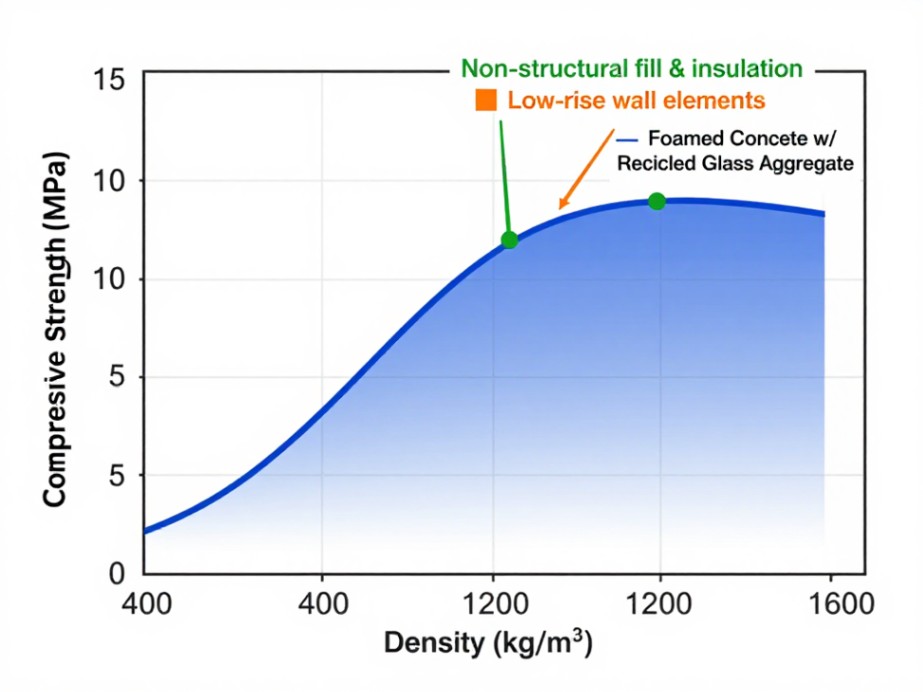
Strength is not sacrificed. The glass aggregate is harder than natural sand. It provides a rigid skeleton within the foamed paste. You achieve a range of compressive strengths, typically from 1 MPa to 15 MPa, by controlling the foam volume. Densities range from 400 kg/m³ to 1600 kg/m³. For non-structural fills, insulation, and low-rise wall elements, this performance envelope is ideal.
3. Durability & Fire Resistance
Glass is inert. It does not absorb water or degrade. This improves the long-term durability of the concrete by reducing moisture-related damage. The cementitious matrix completely encapsulates the glass, preventing any alkali-silica reaction risk. The material is also inherently fire-resistant. It will not combust or release toxic fumes.
The Unbeatable Sustainability Case
The environmental logic is straightforward and powerful.
- Waste Diversion: Every ton of glass used is a ton kept from landfill. It closes the loop on a difficult-to-recycle material.
- Resource Conservation: It eliminates the need to mine and process virgin sand or gravel. This preserves natural landscapes and reduces energy consumption.
- Carbon Footprint Reduction: The process uses less cement per volume due to the foam and lighter weight. Combined with using industrial by-products like fly ash, the embodied carbon of the final product plummets.
Where to Use It: Practical Applications
This material solves specific problems on real job sites.
- Insulating Floor Screeds: Pour it over existing floors for superb thermal and acoustic insulation before a final finish.
- Backfill for Retaining Walls: Its light weight reduces lateral earth pressure. Its drainage characteristics are excellent.
- Roof Insulation Slopes: Create falls on flat roofs with a lightweight, insulating material.
- Void Fill & Abandoned Services: Fill old tanks, pipes, and tunnels securely and permanently.
- Precast Non-Loadbearing Blocks: Manufacture lightweight, insulating blocks for partition walls.
Navigating the Challenges
Adoption requires awareness, not avoidance. The main challenge is consistent aggregate supply. You need a clean, size-graded glass stream. Partnering with a reliable processor is the first step. Mix designs require careful adjustment. The glass particles are smoother than sand, which can affect workability. A skilled batching plant manager can adjust admixtures to compensate. These are initial hurdles, not permanent barriers.
The Logical Next Step for Your Project
The data is clear. The performance is proven. Foamed concrete with recycled glass aggregate reduces waste, cuts energy bills, and lightens structural loads. It is a triple-win solution. The only remaining variable is your decision to use it.
Stop researching generic “green concrete.” You need a specific, tested mix design for your climate and application. I have spent twenty years perfecting these formulations. Book a consultation with our team now. We will analyze your project requirements and provide a precise, costed specification to get you started. Let’s turn your sustainability goals into a built reality with superior performance.
Suppiler
We are the global leader in lightweight concrete and advanced engineered foam solutions. Known globally for its commitment to research, innovation, and applied expertise, we have been providing engineered foam solutions since the early 2012’s.
We can supply high-quality concrete admixture and foam concrete related products all over the world.
The company has a professional technical department and quality supervision department, a well-equipped laboratory, and equipped with advanced testing equipment and after-sales customer service center.
If you are interested, please feel free and contact us.